
Building "Less is More" Event-Driven Operations with OpenResty Edge Webhook
For engineers responsible for large-scale distributed systems, building an efficient monitoring system often presents a dilemma: should we pursue an extremely high sampling frequency to minimize latency, or reduce frequency to conserve computing resources and storage?
In traditional monitoring systems, we typically rely on a polling (Polling) mode. External monitoring components send “health checks” to the gateway every minute, or even every few seconds. This approach often results in wasted effort: when the system is operating normally, thousands of HTTP GET requests merely return a series of repetitive 200 OK responses. This not only consumes valuable network and computing resources but, more importantly, it creates a false sense of activity. Crucially, it often introduces an unavoidable delay when a genuine fault actually occurs.
The core problem we face isn’t merely about “speed” or frequency; it’s about the architecture’s signal-to-noise ratio. Can we stop meaningless, repetitive queries and instead receive a clear signal only at the precise moment a critical state change occurs in the infrastructure’s lifecycle? As architects, we need to evolve our operational approach from “frequent polling” to “precise, event-driven notifications.”
From Data Deluge to Critical Signals
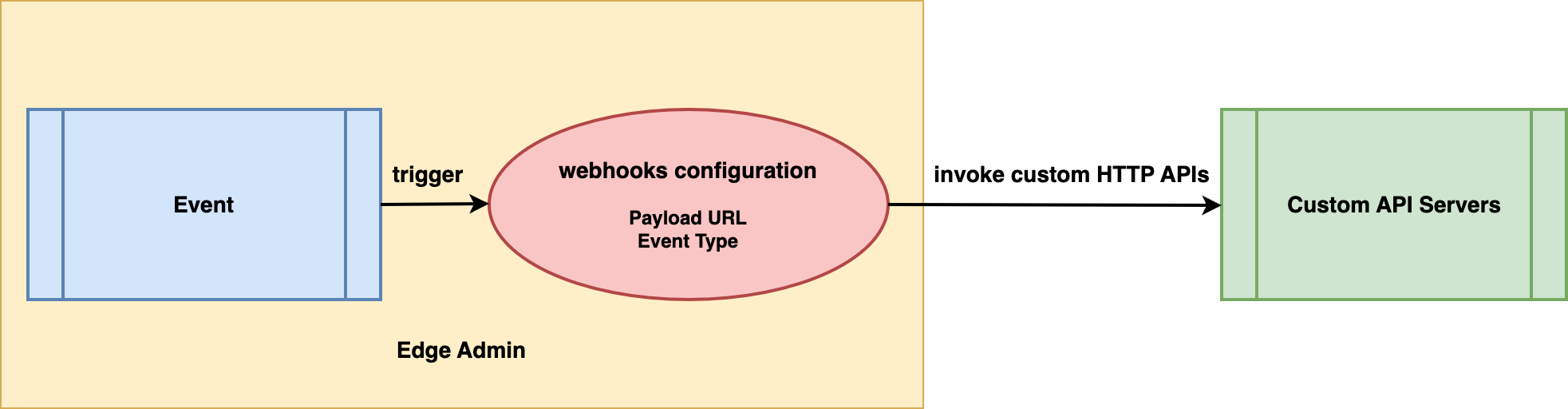
The Webhook mechanism introduced by OpenResty Edge embodies the “less is more” design philosophy. Its purpose isn’t to stream massive access logs to users in real-time (which would create immense storage pressure and unnecessary processing overhead), but rather to serve as a core state notification mechanism for the control plane.
When OpenResty Edge’s internal health check mechanism detects a critical infrastructure-level event (for instance, a gateway node going offline), it captures this state change. Immediately, it pushes standardized event data to your pre-configured URL via an HTTP POST request.
This mechanism delivers strategic advantages:
- Eliminate Noise: We don’t send out routine traffic logs. Instead, we focus exclusively on infrastructure status changes that genuinely impact service availability. This ensures that every Webhook notification is a meaningful “signal” that demands attention, not just “noise” to be filtered out.
- Resource Decoupling: Your monitoring system no longer needs to consume resources by continuously polling OpenResty Edge’s status. OpenResty Edge will proactively inform you “what happened” precisely when it matters, allowing your external systems (such as ticketing systems or automation scripts) to concentrate on “how to respond.”
- Simplify Complexity: You’ll no longer need to write intricate external scripts to constantly poll API endpoints, thereby eliminating inefficient and unnecessary polling traffic.
- Seamless Integration: Whether it’s triggering PagerDuty alerts, driving Kubernetes for automatic scaling, or updating external status pages, everything can be interconnected through a simple HTTP interface via Webhooks.
- Deterministic Architecture: The system initiates processes immediately upon confirming a status change, making subsequent automated operational actions predictable and timely, rather than relying on the hit-or-miss nature of scheduled polling.
Why is Edge Webhook So Efficient and Secure?
You might be wondering if adding event capture and notification capabilities to a gateway that handles massive requests would impact the performance of your core business traffic. The answer is a resounding: No.
This remarkable efficiency and security are made possible by the underlying architectural design of OpenResty Edge.
Key Reason: Complete Isolation of Event Processing from Business Traffic
- Business traffic runs on the Edge Node (data plane), which is exclusively focused on ultra-high performance processing and forwarding of user requests.
- Webhook events (such as configuration deployment, certificate updates, health check status changes, etc.) originate from the Edge Admin console (management plane), which is responsible for configuration management and system monitoring.
- Therefore, the Webhook processing workflow operates on a completely separate architectural layer from the core business traffic handled by the Edge Node, resulting in zero performance impact on your business operations.
Efficient and Reliable Event Processing in the Control Plane:
- Even when event sources originate from the Edge Admin, we ensure highly efficient and reliable event delivery. Webhook event capture and HTTP push operate in a completely asynchronous, non-blocking mode.
- When an event is triggered, OpenResty Edge places it into an independent asynchronous task queue, to be processed by lightweight background Worker processes.
- This means that even if your recipient API responds slowly or is temporarily unavailable, it will never block or delay Edge Admin’s configuration and management functionalities. OpenResty Edge’s background task processor handles retries, ensuring reliable event delivery.
Kernel-Level Efficient Event Capture:
- Leveraging OpenResty’s powerful LuaJIT runtime, OpenResty Edge can capture events from its core components (such as configuration synchronization, health checks, and logging systems) with extremely low performance overhead.
- This deeply integrated approach is more direct and efficient than external log analysis or API polling, ensuring you receive accurate, real-time system status updates.
Architecture Schematic:
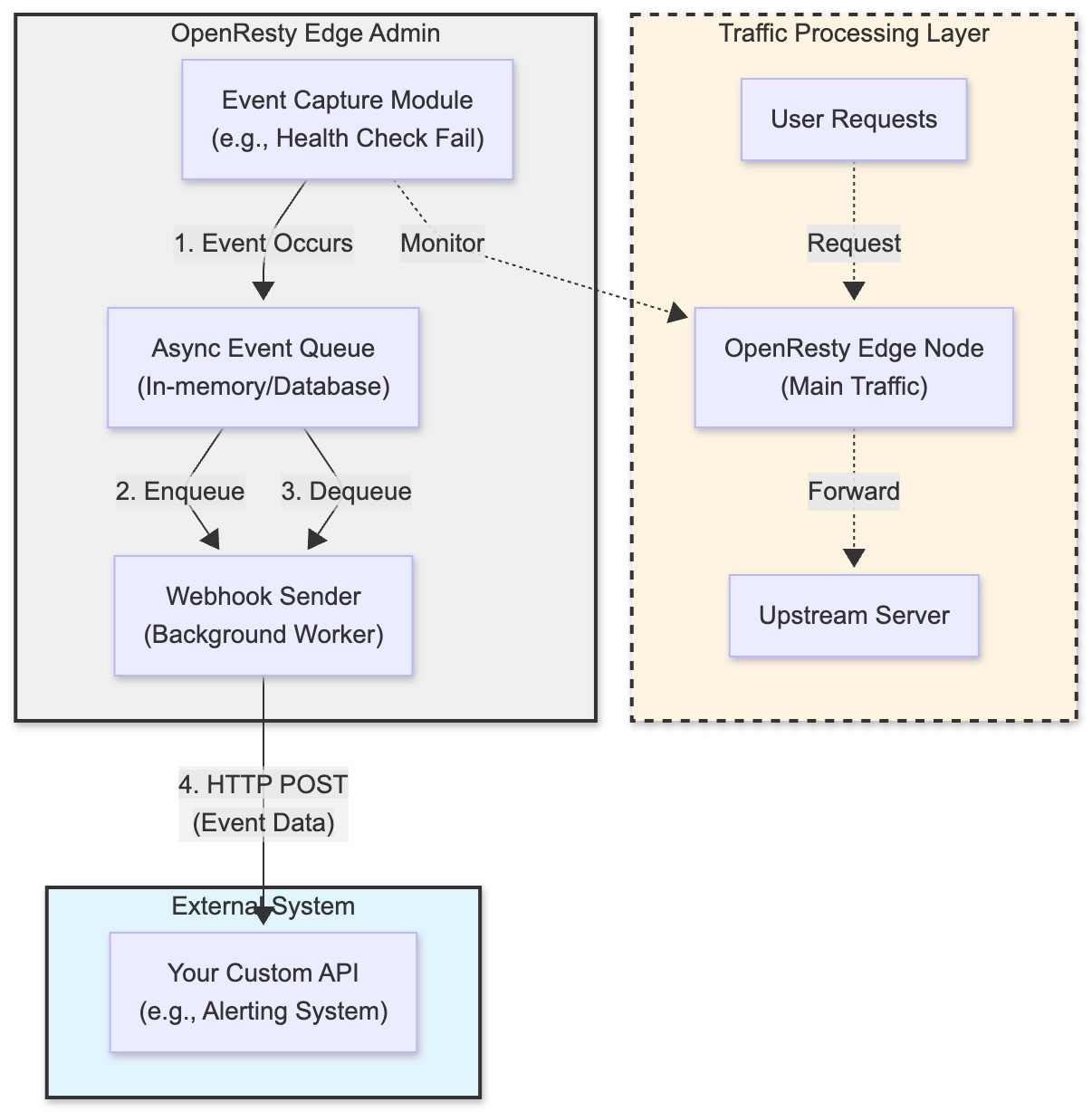
As depicted in the diagram above, the capture, queuing, and sending of events (steps 1-4) are completely independent of the primary traffic path that processes user requests.
Building a “Less is More” Precise Operations Ecosystem
The “gateway server offline” scenario exemplifies the core philosophy of OpenResty Edge Webhook: focusing on critical signals, rather than being drowned out by noise.
Amidst the vast amount of operational data, not every log needs to trigger a disruptive alert. The design philosophy of OpenResty Edge emphasizes restraint and precision—we focus on capturing core state changes that truly impact infrastructure availability.
By outputting these high-value core signals via Webhook, you can build a highly customized downstream ecosystem:
- **ChatOps Integration**: Connect Webhooks to Slack or DingTalk bots. When the status of a core node changes, your team can receive immediate updates in group chats without logging into the console, effectively breaking down information silos.
- **Ticketing System Integration**: Integrate with Jira or PagerDuty. Incident tickets are automatically created only when substantial infrastructure anomalies are confirmed, preventing operational fatigue caused by false positives.
- **Customizable Self-Healing**: For advanced users, lightweight Serverless functions (such as AWS Lambda) can be written to act as Webhook receivers. Upon receiving a node offline signal, these functions can automatically trigger DNS failover or elastic scaling of cloud resources, achieving unattended, closed-loop remediation.
The true value of technology lies not in acquiring massive amounts of redundant data through polling, but in enabling systems to respond deterministically when critical moments arise.
- Get Started Now: If you wish to immediately configure “Node Offline Alerts” for your production environment, please read our guide on Configuring Webhooks in OpenResty Edge.
- Learn More: For detailed information on event parameters and APIs, please consult the official OpenResty Edge documentation.
The Webhook mechanism in OpenResty Edge is designed to help you bridge the “last mile” of IT operations monitoring with minimal configuration. Say goodbye to inefficient polling scripts and empower your architecture to respond with reflexive speed and automation when critical failures occur.
What is OpenResty Edge
OpenResty Edge is our all-in-one gateway software for microservices and distributed traffic architectures. It combines traffic management, private CDN construction, API gateway, security, and more to help you easily build, manage, and protect modern applications. OpenResty Edge delivers industry-leading performance and scalability to meet the demanding needs of high concurrency, high load scenarios. It supports scheduling containerized application traffic such as K8s and manages massive domains, making it easy to meet the needs of large websites and complex applications.
If you like this tutorial, please subscribe to this blog site and/or our YouTube channel. Thank you!
About The Author
Yichun Zhang (Github handle: agentzh), is the original creator of the OpenResty® open-source project and the CEO of OpenResty Inc..
Yichun is one of the earliest advocates and leaders of “open-source technology”. He worked at many internationally renowned tech companies, such as Cloudflare, Yahoo!. He is a pioneer of “edge computing”, “dynamic tracing” and “machine coding”, with over 22 years of programming and 16 years of open source experience. Yichun is well-known in the open-source space as the project leader of OpenResty®, adopted by more than 40 million global website domains.
OpenResty Inc., the enterprise software start-up founded by Yichun in 2017, has customers from some of the biggest companies in the world. Its flagship product, OpenResty XRay, is a non-invasive profiling and troubleshooting tool that significantly enhances and utilizes dynamic tracing technology. And its OpenResty Edge product is a powerful distributed traffic management and private CDN software product.
As an avid open-source contributor, Yichun has contributed more than a million lines of code to numerous open-source projects, including Linux kernel, Nginx, LuaJIT, GDB, SystemTap, LLVM, Perl, etc. He has also authored more than 60 open-source software libraries.
Related Articles
OpenResty XRay Dec 15, 2025

OpenResty XRay Nov 17, 2025

OpenResty XRay Nov 11, 2025

OpenResty XRay Oct 20, 2025

OpenResty XRay Oct 15, 2025