
How to Benchmark Lua Code in OpenResty: ngx.now(), JIT Warmup, and GC
Check out how OpenResty XRay helps organizations troubleshoot issues and optimize the performance of their applications.
 Learn More
LIVE DEMO
Learn More
LIVE DEMOBenchmarking Lua code in OpenResty means measuring the execution time of a Lua function under realistic, steady-state conditions — not a one-shot cold run. A naïve time resty measurement includes the resty process startup and shutdown overhead (around 11 milliseconds on the author’s test machine), which completely swamps the nanosecond-scale cost of a single function call. The correct approach uses ngx.now() to isolate elapsed time, a JIT warmup loop to ensure the target function is compiled before recording starts, and an optional collectgarbage() call to flush pending GC objects.
This tutorial demonstrates both the right ways and wrong ways of benchmarking user Lua code in OpenResty.
cd ~
mkdir time-lua
cd time-lua/
First of all, make sure our CPU is always at its full speed.
echo performance | sudo tee /sys/devices/system/cpu/cpu*/cpufreq/scaling_governor
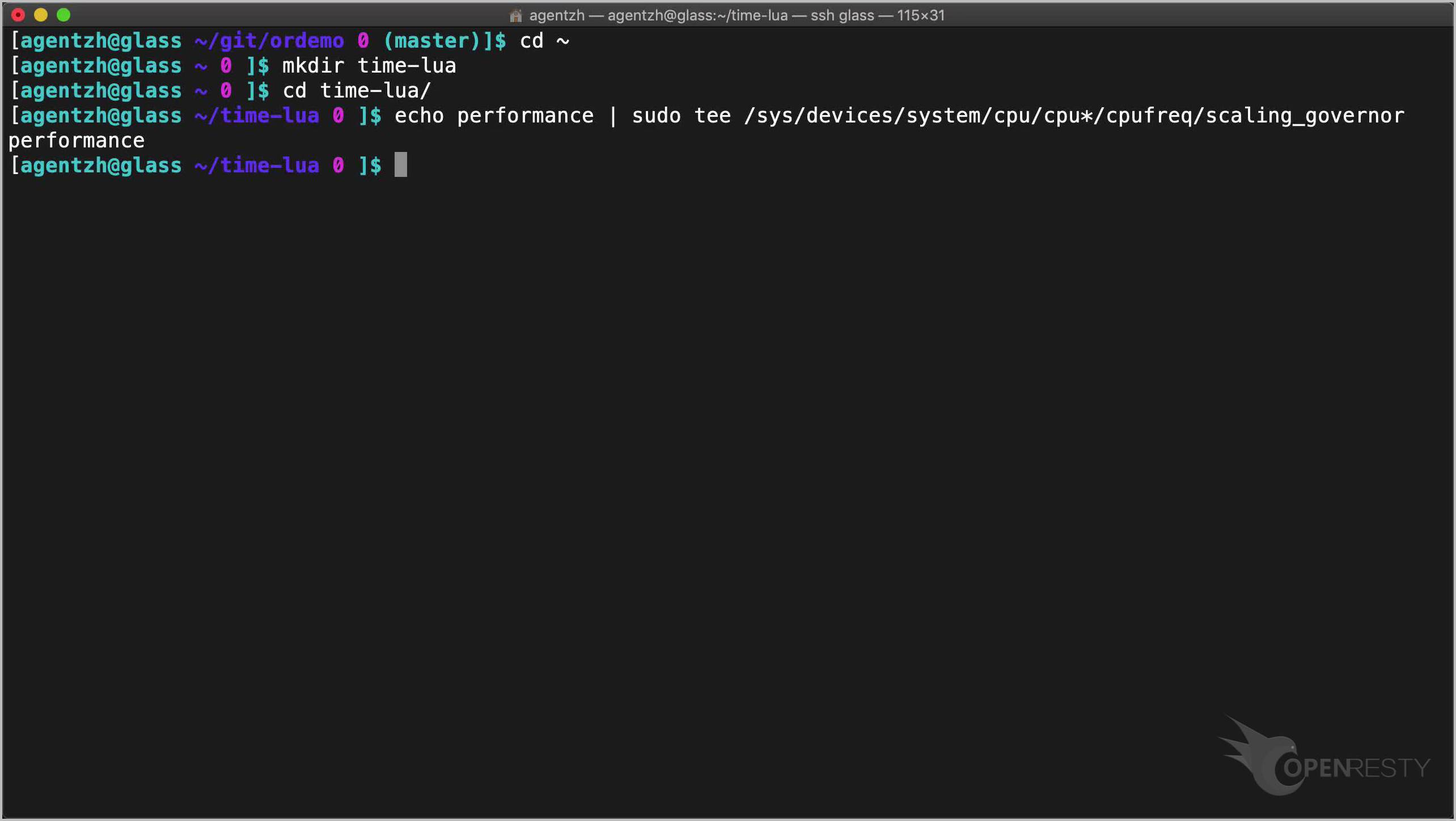
It usually takes the value powersave by default and we need to set it to performance instead.
Why time resty Gives Inaccurate Results
The simplest way to time some Lua code is to use the time command with the resty command.
time resty -e 'ngx.re.find("hello, world.", [[\w+\.]], "jo")'
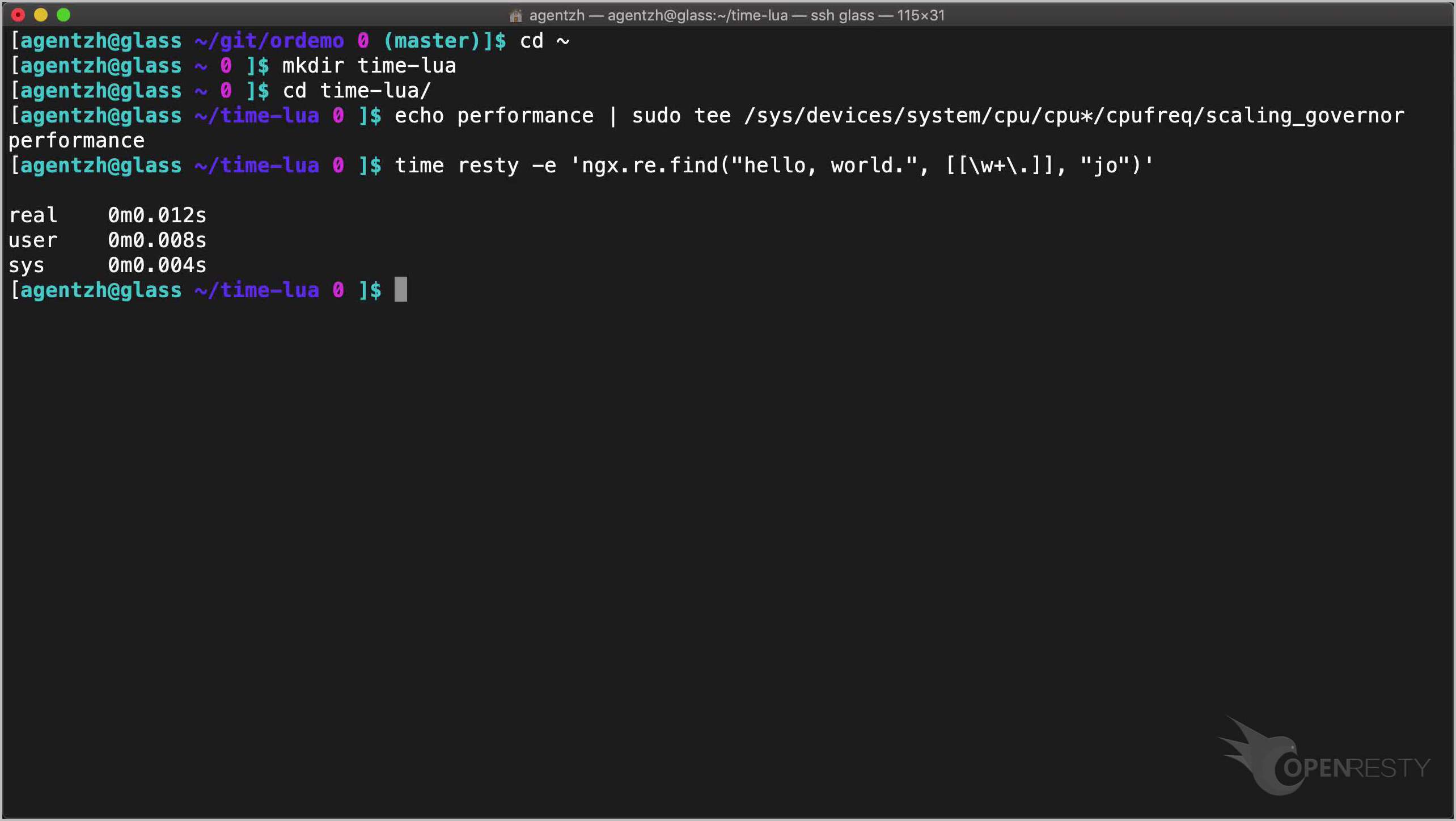
But there is a catch. The resty command itself has a startup and exiting overhead.
time resty -e ''
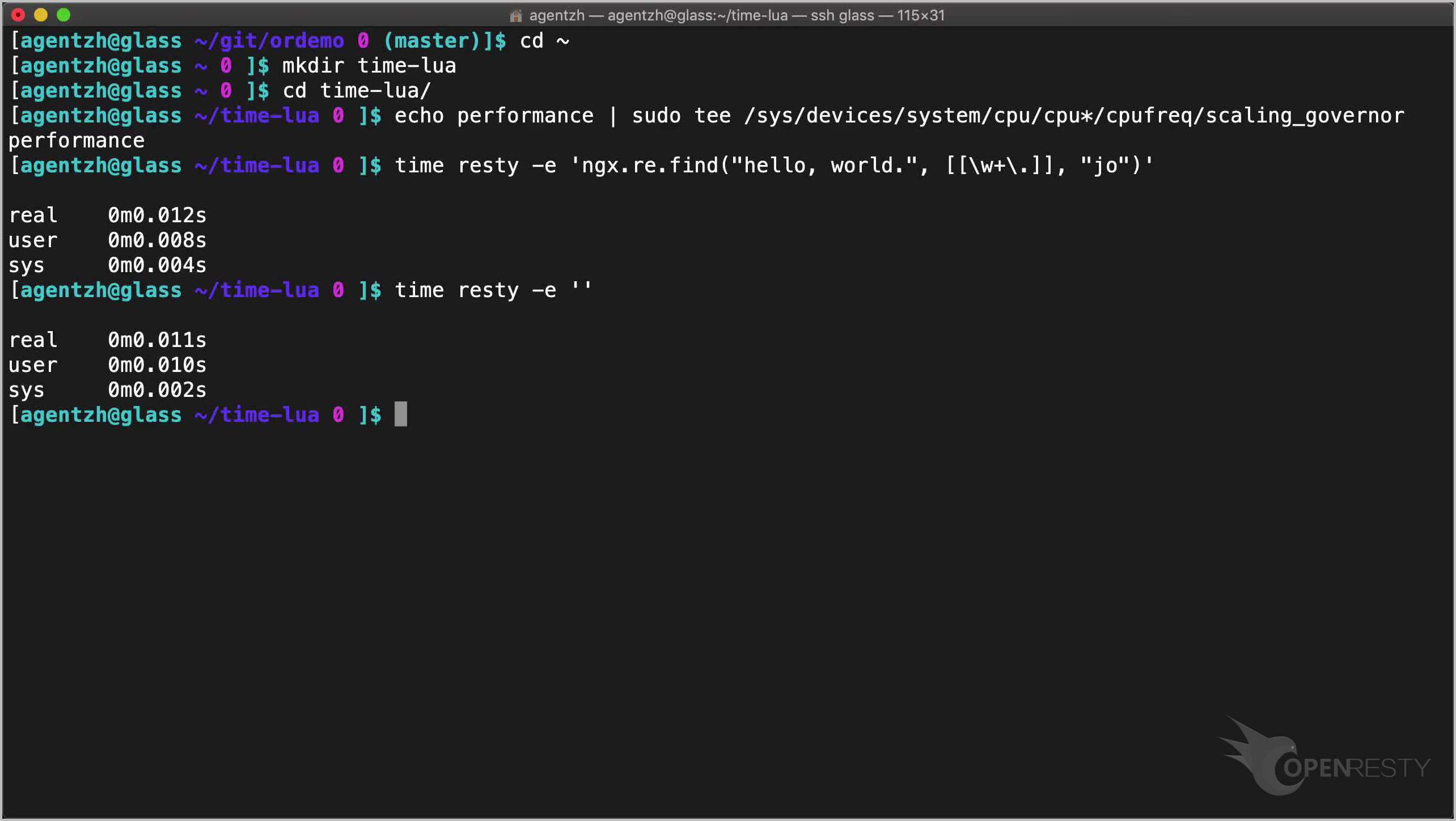
We can see there’s overhead of about 11 milliseconds on this machine.
Measuring Elapsed Time with ngx.now()
Instead, we should use the ngx.now Lua API function provided by OpenResty. Use restydoc to look up its documentation:
restydoc -s ngx.now
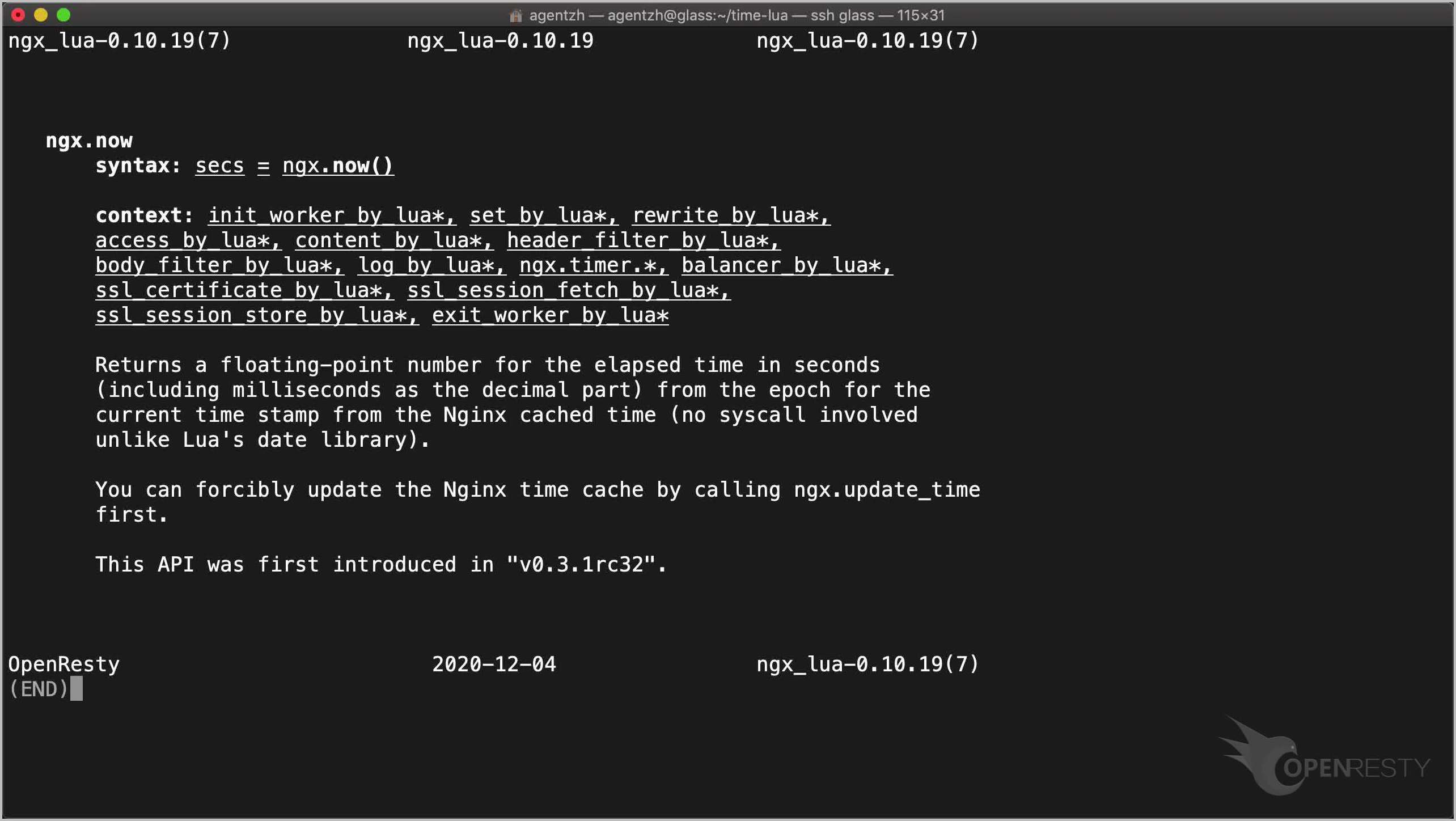
Let’s put our Lua code into a file named ./bench.lua for better readablility.
We make the following edits:
- First of all, we make sure the cached time inside nginx is up to date.
- And then we record the begin time which has millisecond precision.
- And then put our aforementioned regex matching call.
- And then we update our cached time again.
- Finally, output the elapsed time by doing a time subtraction.
- Let’s save the file.
ngx.update_time()
local begin = ngx.now()
ngx.re.find("hello, world.", [[\w+\.]], "jo")
ngx.update_time()
ngx.say("elapsed seconds: ", ngx.now() - begin)
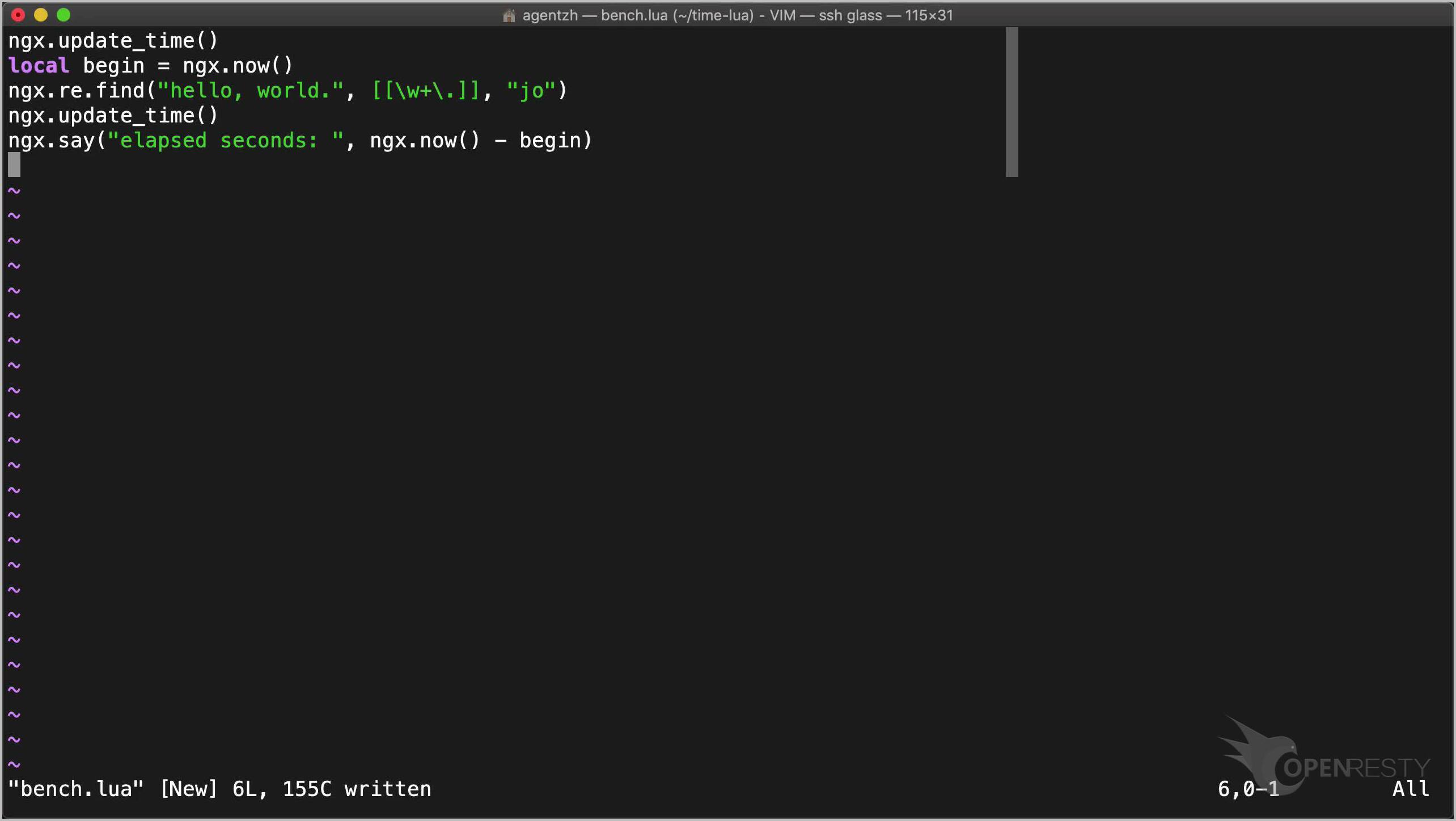
Then run the resty shell command.
resty bench.lua
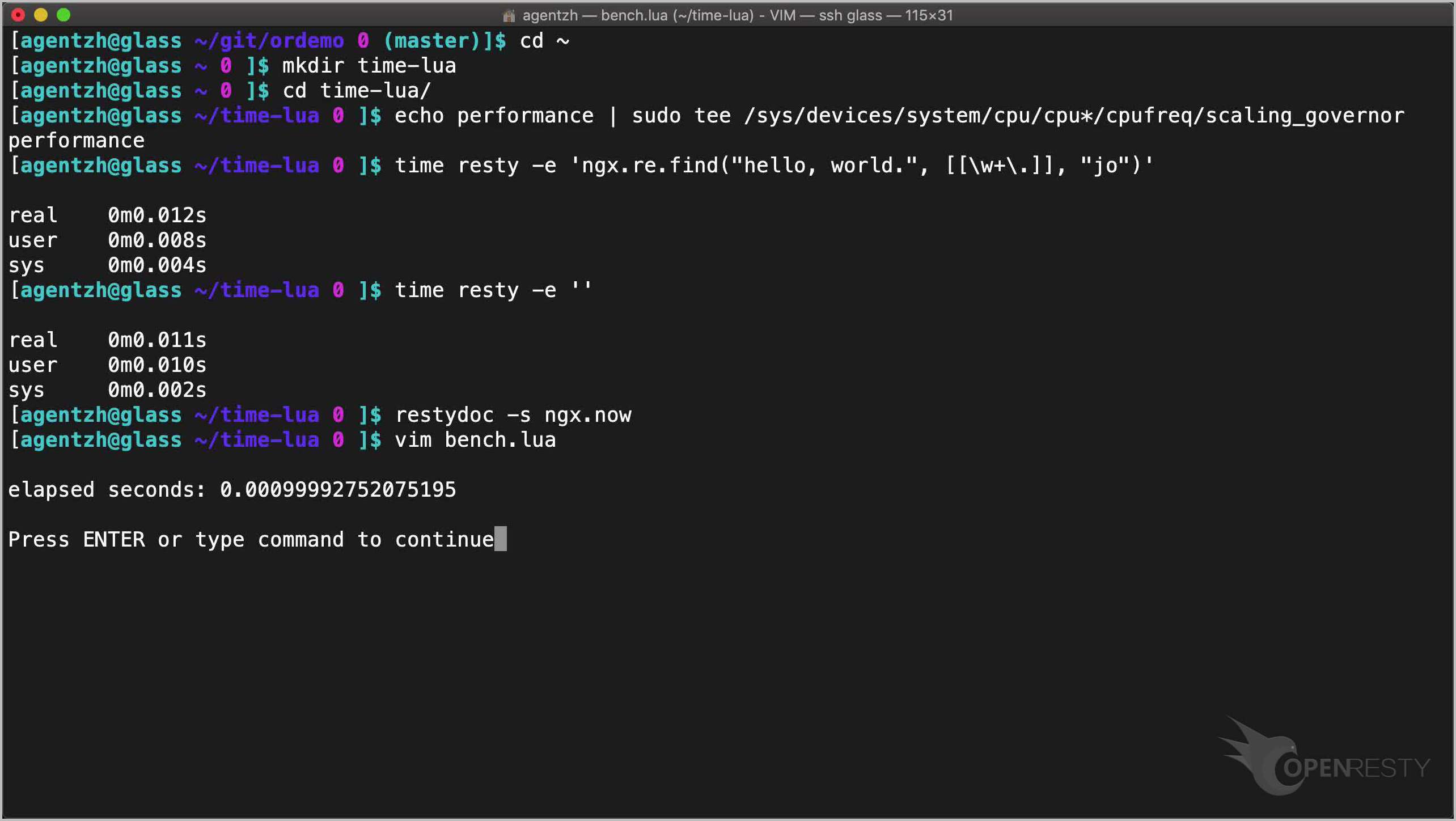
It records about a latency of about 1 millisecond. But we will soon see it is very inaccurate.
Warming Up LuaJIT Before Recording
The correct way is to make the following edits in the bench.lua file:
- Put the call into a Lua function named
target. - And then call this function first for 100 times as a warmup. Now this
targetfunction should be JIT compiled after this loop is executed. - And then inside the timed code region, we call it repeatedly for 10 million times.
- Finally we compute the average time.
local function target()
    ngx.re.find("hello, world.", [[\w+\.]], "jo")
end

for i = 1, 100 do
    target()
end

ngx.update_time()
local begin = ngx.now()

local N = 1e7
for i = 1, N do
    target()
end

ngx.update_time()
ngx.say("elapsed: ", (ngx.now() - begin) / N)
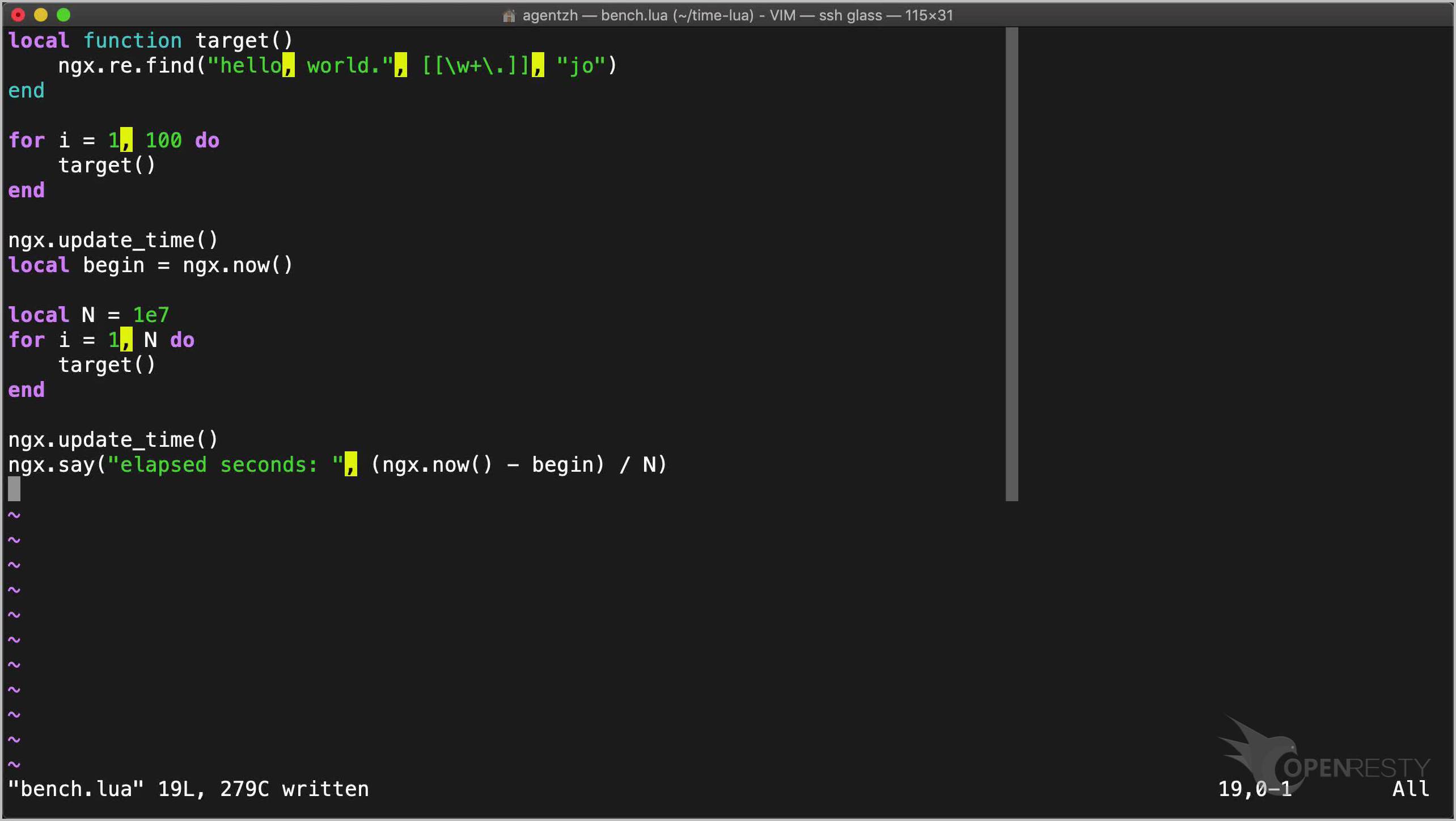
We now run this script again.
resty bench.lua
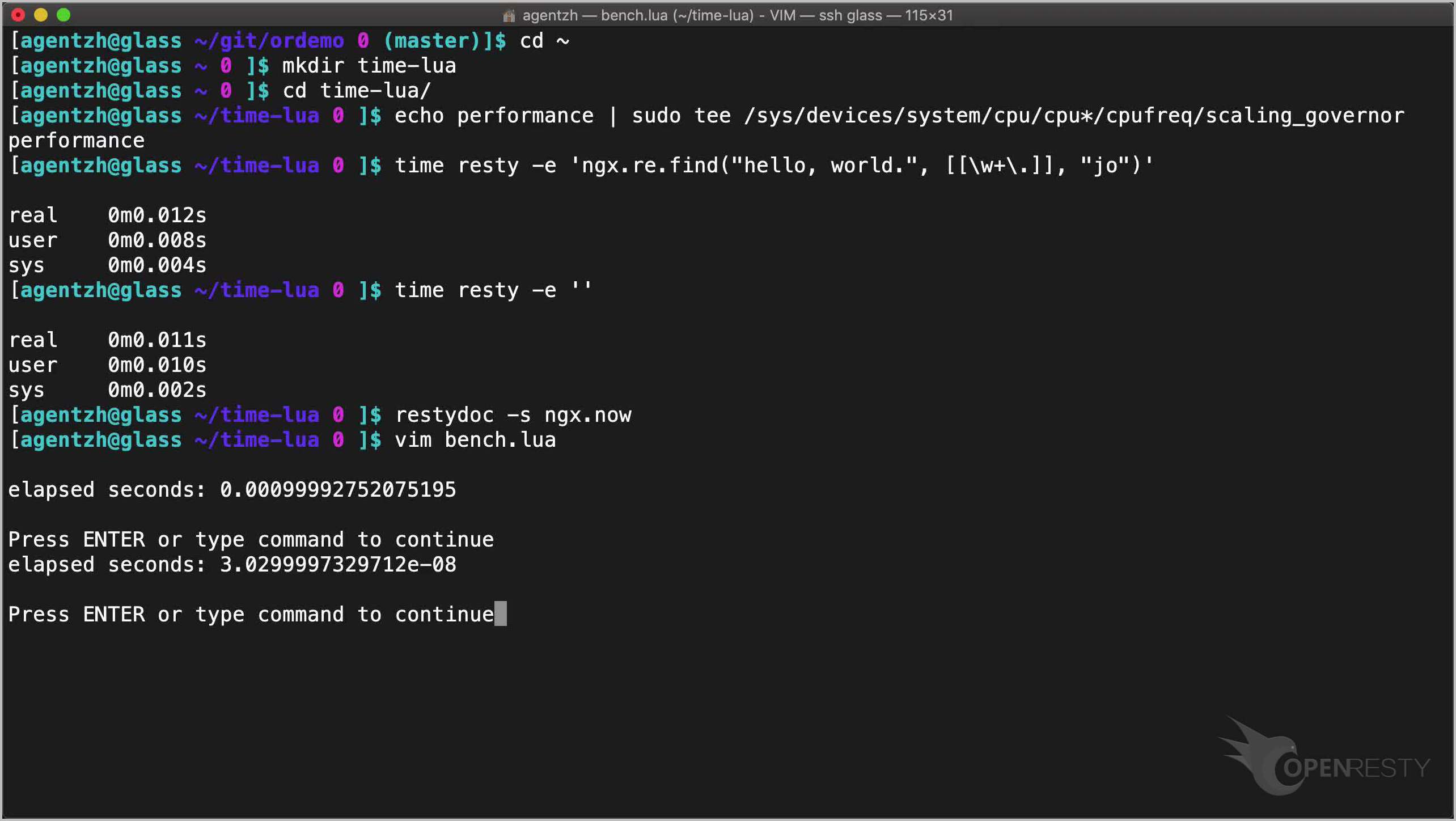
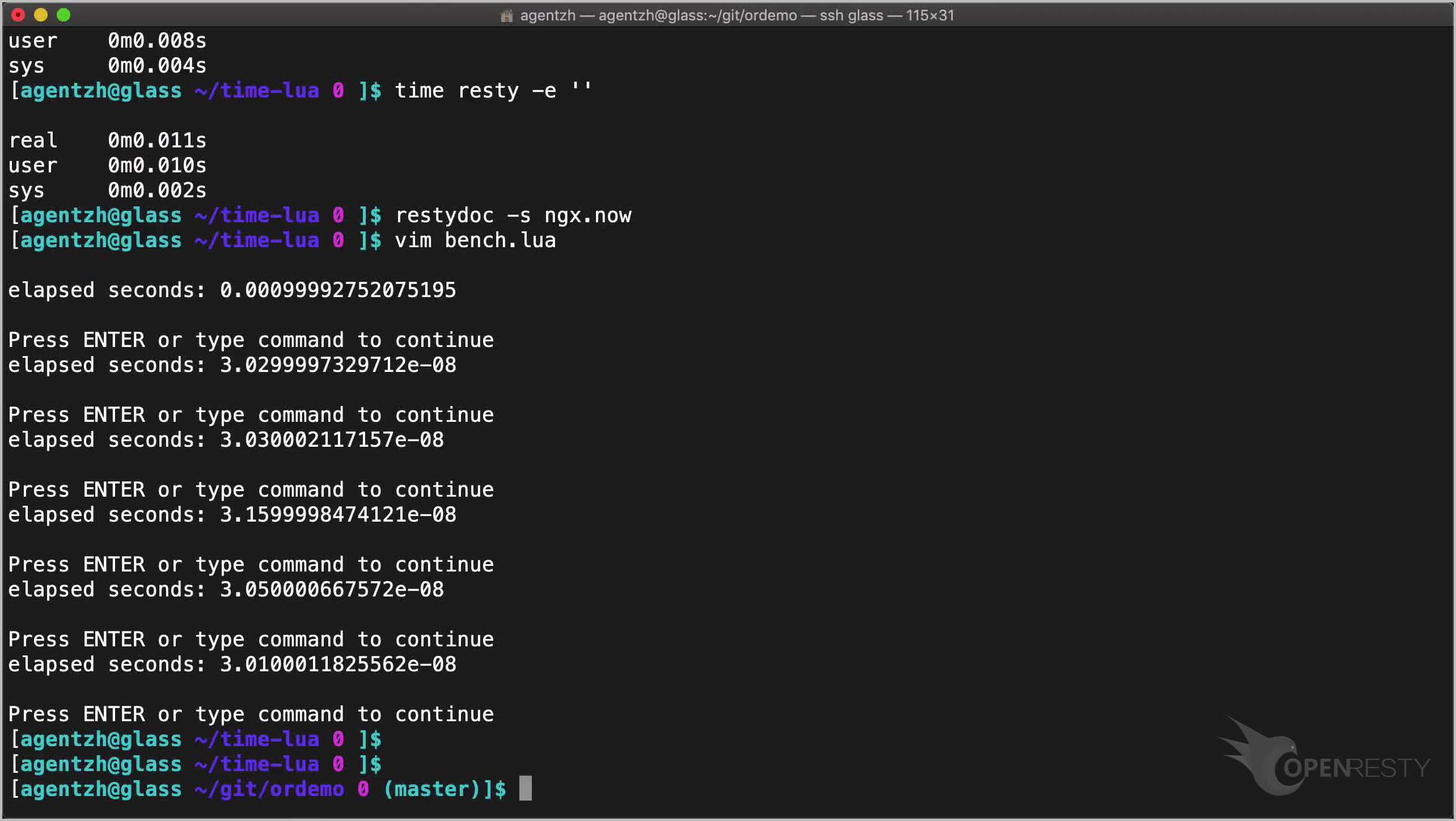
We can see that it is merely about 30 nanoseconds per call. So many many times faster than the previous result!
Flushing GC Objects for Consistent Results
Actualy we can further make sure no dead GC objects hanging around before we time the code. Just insert the following line of code before the first ngx.update_time() call.
collectgarbage()
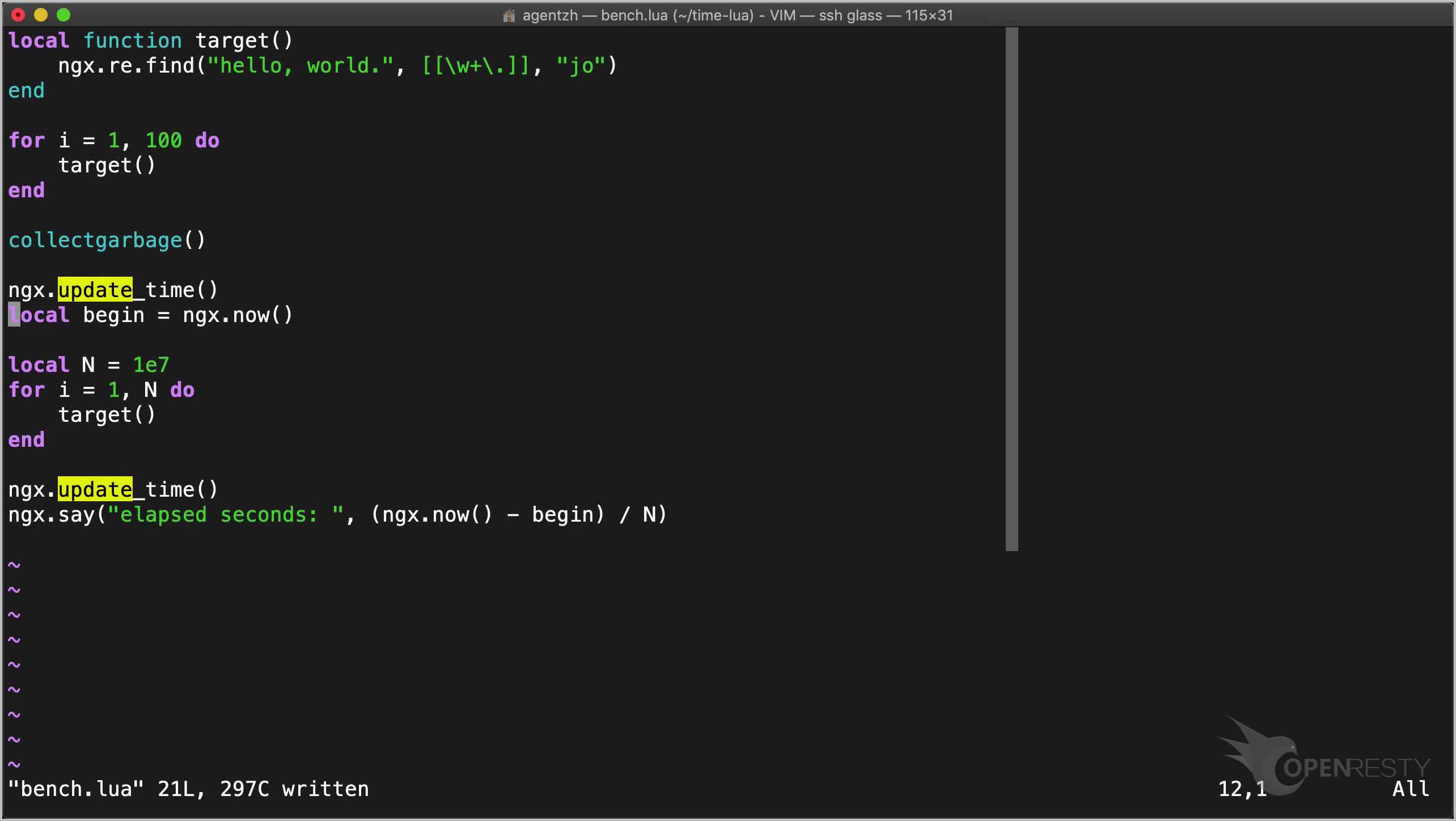
Here we force a full GC cycle before recording the begin time.
It does not help much with our example here, however. This is because our timed code does not create many GC objects anyway.
Reducing Overhead in the Benchmark Target
We can make the target function faster by avoiding unnecessary Lua table lookup operations.
local re_find = ngx.re.find

local function target()
    re_find("hello, world.", [[\w+\.]], "jo")
end
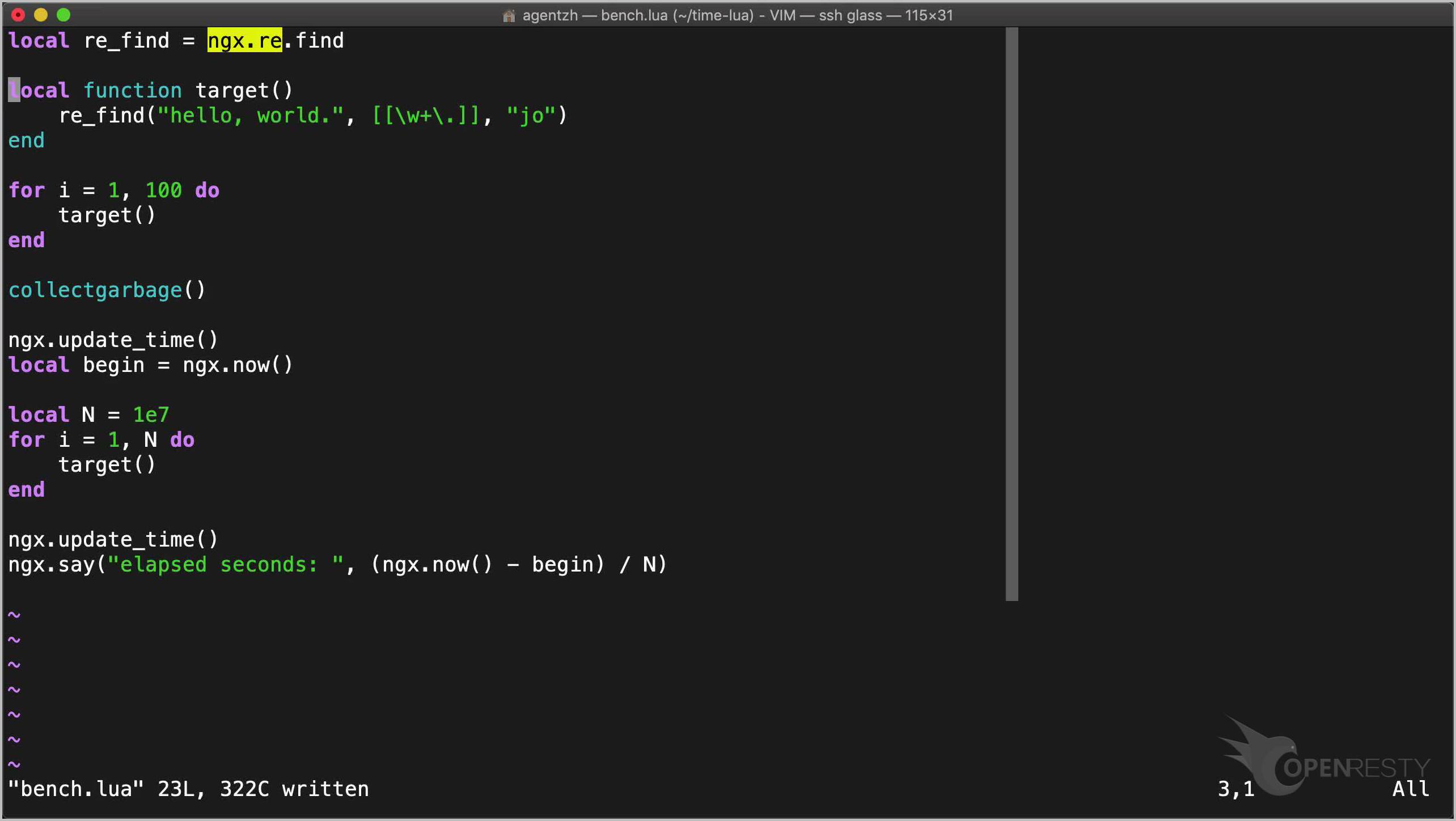
But the difference may not be measurable here.
This is what I’d cover today. Hopefully you find it interesting.
If you like this tutorial, please subscribe to this blog site and our YouTube channel. Thank you!
Continue the OpenResty Tutorial Series
← Prev: CLI Tools: resty & restydoc | You are here: Benchmarking Lua Code | Next: LuaJIT Bytecode Precompilation →
View the full OpenResty Tutorial Series →
Frequently Asked Questions
Why should I not use the shell time command to benchmark Lua code in OpenResty?
The time resty command includes the startup and shutdown overhead of the resty process itself — around 11 milliseconds on the author’s test machine. This overhead completely swamps the nanosecond-scale execution time of a single Lua function call, making the result useless for micro-benchmarking.
What is ngx.now() and why is it better for benchmarking?
ngx.now() is a high-precision OpenResty API that returns the current wall-clock time in seconds, reading from nginx’s internal cached clock. By calling ngx.update_time() immediately before each read, you get an accurate elapsed time measurement that is not affected by the resty process startup cost.
Why does LuaJIT need a warmup loop before I start timing?
LuaJIT compiles Lua functions to native machine code only after they are called enough times. A function measured on its first few calls runs in the slower interpreter mode. Running a warmup loop of around 100 iterations before recording — as this tutorial demonstrates — ensures the target function is JIT-compiled, so the benchmark reflects steady-state throughput rather than one-off interpreter overhead.
Does flushing GC objects always improve benchmark accuracy in OpenResty?
Not necessarily. Calling collectgarbage() before recording forces a full GC pass upfront, which prevents a GC cycle from triggering mid-benchmark. However, as the author notes in this tutorial, it does not help much if your timed code does not create many GC objects in the first place. It is a useful precaution for benchmarks that allocate heavily, but not a guaranteed improvement.
About The Author
Yichun Zhang (Github handle: agentzh), is the original creator of the OpenResty® open-source project and the CEO of OpenResty Inc..
Yichun is one of the earliest advocates and leaders of “open-source technology”. He worked at many internationally renowned tech companies, such as Cloudflare, Yahoo!. He is a pioneer of “edge computing”, “dynamic tracing” and “machine coding”, with over 22 years of programming and 16 years of open source experience. Yichun is well-known in the open-source space as the project leader of OpenResty®, adopted by more than 40 million global website domains.
OpenResty Inc., the enterprise software start-up founded by Yichun in 2017, has customers from some of the biggest companies in the world. Its flagship product, OpenResty XRay, is a non-invasive profiling and troubleshooting tool that significantly enhances and utilizes dynamic tracing technology. And its OpenResty Edge product is a powerful distributed traffic management and private CDN software product.
As an avid open-source contributor, Yichun has contributed more than a million lines of code to numerous open-source projects, including Linux kernel, Nginx, LuaJIT, GDB, SystemTap, LLVM, Perl, etc. He has also authored more than 60 open-source software libraries.
Related Articles
OpenResty XRay Dec 9, 2020

OpenResty XRay Dec 1, 2020

OpenResty XRay Nov 29, 2020

OpenResty XRay Nov 15, 2020

OpenResty XRay Nov 14, 2020