CDN for Live Streaming: Surviving Peak Events Without Peak-Event Bills
Major sporting events are a public stress test for live streaming architecture: every top-tier tournament sees some platform stutter or go down during a key match, and some platform discovers, after the event, that its delivery bill grew faster than its revenue.
Across our years serving many CDN vendors and live streaming platforms, this kind of peak failure has one frequent and easily underestimated cause: not a bandwidth shortfall, but runaway origin-fetch architecture — with every order-of-magnitude jump in audience size, the pressure that origin fetches put on the origin compounds. This convergence mechanism must be done right whether you run a public CDN or a private CDN; the difference is who controls it and how it is billed. Written for technical decision-makers in the live streaming business, this article analyzes the causes of such failures, works through the cost structure of both models, and explains what kind of business is suited to bringing the delivery layer back in-house.
Why live streams crash at peak: running day-to-day doesn’t mean surviving the peak
The traffic profile of event streaming is fundamentally different from everyday business: viewers pour in within the same minute the opening whistle blows, with no ramp-up to the peak; a match is not replayed just because of a failure, so failure is irreversible and directly affects rights-holder relationships and user retention.
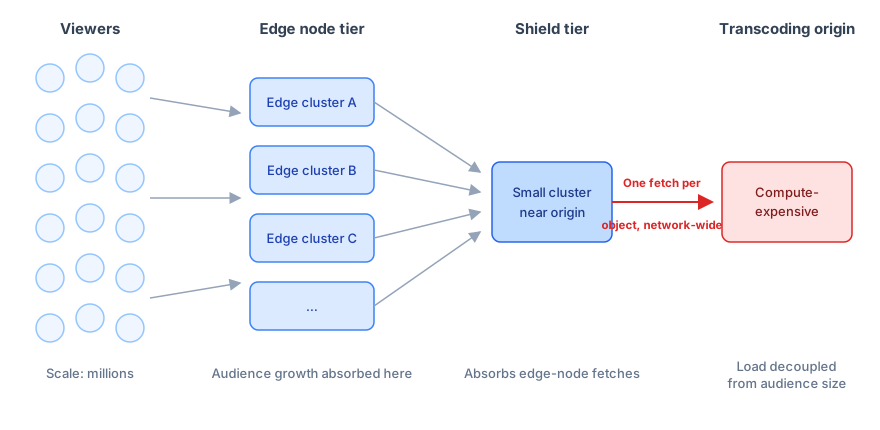
More important is the mechanism of the crash. Live content is refreshed every few seconds by design, and each refresh requires the delivery layer to fetch data from the origin again. When the cache-deduplication mechanism is not airtight, a fetch that should be completed by a single request turns into hundreds or thousands of viewer requests punching through to the origin simultaneously — as if a stadium opened only one entrance gate. And the origin bearing these punch-through requests is, in essence, just an output server at the tail of the transcoding pipeline: no matter how many viewers watch, the upstream transcoding work is done only once, so its bandwidth and connection capacity are planned around “how many times each object is fetched,” never around the CDN scale of a viewer-facing tier. The storm saturates exactly this not-so-generous link.
Once punch-through happens, the failure amplifies itself along a fixed timeline: the origin link is saturated first, so origin fetches slow down; the slowdown triggers timeouts at every layer, and the timeouts release a fresh wave of retry requests, pushing pressure higher still; within minutes, every node and every viewer’s stream degrades together. Adding bandwidth on the fly is useless here — the bottleneck is not the egress on the delivery side, but the ingress on the origin side.
This process is completely invisible under everyday traffic: at low concurrency, dedup failures are just a few redundant fetches, and the monitoring curves look perfectly normal. “It runs day-to-day” proves nothing — the seed of a peak failure is in the architecture, and it only sprouts at peak. This is why you must load-test at peak scale before the event, rather than relying on day-to-day operating records.
How a private CDN turns peak stability from probability into certainty
To be clear, “surviving the peak” is a threshold set by the scenario itself, the same for any delivery approach; a public CDN must clear it too. The difference is not in the requirement, but in who controls how it is met.
Public CDN providers are professionals — the convergence mechanisms from the previous section are implemented just as well inside a mature vendor’s network; that is their stock-in-trade. But for the operator, these mechanisms are the vendor’s implementation details: the contract specifies a service level, not the controls to adjust origin-fetch policy or degradation logic. For most businesses, this encapsulation is precisely the value of the public-CDN model — you don’t have to worry about the underlying layer.
What deserves weighing is a different class of business: one where live streaming is the core business itself, where every minute of peak night maps directly to revenue and rights obligations. Such teams often want to be able to audit, load-test, and adjust the origin-protection strategy themselves, mid-event — not out of doubt about the vendor’s competence, but as the general requirement of keeping a critical link under one’s own control, the same way any company of sufficient scale eventually brings its core systems in-house. A private CDN answers exactly this need: commercial delivery software deployed on the operator’s own infrastructure, with the team holding all the policies. In this architecture, origin-fetch behavior can be collapsed into a verifiable fact: whether ten thousand or ten million viewers are online, the origin handles only one request per content object — audience growth happens entirely at the edge tier, and origin load is decoupled from audience size.
This “once” is not a service-level promise but an architectural property, and it brings three capabilities that do not exist in the public-CDN model:
- Verifiable before the event: in a load test, double the simulated audience and the origin request count should stay unchanged — an objective criterion you can write into a go-live checklist, rather than a vendor’s verbal assurance.
- Adjustable during the event: policy changes take effect in real time, without waiting on any external response process.
- Degradable on failure: when the origin fails for a few dozen seconds, the edge tier keeps serving viewers the last valid content, playback does not break, and it resumes seamlessly once the origin recovers — what viewers see is “the stream is slightly delayed,” not everyone erroring out at once.
This mechanism has been validated in a real production deployment for a globally watched, major sporting event broadcast: during the peak, the origin only ever bore a load of “once per object” from start to finish, while the expensive upstream transcoding stage was entirely unaffected.
Live streaming CDN cost comparison: surviving the peak isn’t paying for the peak
A natural rebuttal to the previous section: never mind control — just buy more public CDN capacity and trade redundancy for stability. This is exactly where the numbers matter. The difference between the two models can be summarized in a table:
| Dimension | Public CDN | Private CDN |
|---|---|---|
| Billing basis | By total delivered traffic (per GB) | By capacity: servers, data-center bandwidth (by sustained peak or fixed port), software |
| When audience doubles | Bill roughly doubles | Only edge nodes scale out; cost rises in small steps |
| Peak-event capacity | Pay year-round for redundancy, or accept costly burst billing | One-time capacity investment, amortized further with every event |
| Origin-protection strategy | Handled by the vendor’s professional team | Configured by your own team; can be load-tested and adjusted in-house |
| Failure-handling path | Goes through the vendor’s support process | Your own team handles it directly |
| Policy and data ownership | Inside the vendor’s network | Inside the operator’s own infrastructure |
The difference in cost structure comes from an architectural fact: a public CDN bills by traffic, so a live stream’s cost grows linearly with business success — audience doubles, bill doubles, making live streaming one of the few business lines where “growth doesn’t improve margin” — and peak capacity is precisely the most expensive part of the public-CDN model: for a few peak events a year you either pay year-round for redundant capacity or accept costly burst billing. Per-GB CDN prices are indeed falling year over year across the industry, but live bitrates and audience sizes grow faster, so total bills rise rather than fall — the shared experience of many streaming platforms.
A private CDN also pays for bandwidth; the cost is not unrelated to traffic — the difference lies in the billing form. Owned bandwidth is billed by sustained peak capacity, and the industry-standard method discards the highest short burst window each month: the short spikes of a few match nights in a month largely don’t enter the bill directly, whereas under traffic-based billing every byte during the peak is billed. Add that the unit cost of owned bandwidth is itself lower than a per-delivery rate, and the larger the audience, the wider the gap between the two forms. On the scaling side, because origin load is decoupled from audience size, what you add is only edge nodes; the transcoding and origin stages don’t need more investment as the audience grows. Exactly which audience size makes a private CDN more economical varies by business, but the trend is certain: the larger the audience and the more frequent the streaming, the more pronounced the private CDN’s cost advantage. For teams in a transitional phase, the two can also be mixed: the private CDN carries baseline traffic and origin protection, with a public CDN as overflow for regional or burst traffic.
The real cost of a private CDN: not the same as building from scratch
The last common concern about a private CDN is the cost of implementation: “this sounds like it needs a dedicated low-level software team.”
That worry is aimed at one path in particular — “assembling from open-source components from scratch.” Going down that path does require a dedicated team for long-term maintenance; and it’s not as sound as it looks: the risk of a public CDN is “your lifeline is in the vendor’s black box,” and building from scratch merely swaps that risk for another form — “your lifeline is in the hands of the few engineers who understand the system, and when one leaves there’s no one to take over.” In other words, building from scratch is neither the only way to realize a private CDN, nor a good one.
As a product category, a private CDN means not in-house R&D but commercial software deployed on your own infrastructure. Take OpenResty Edge: gateway nodes run on the operator’s own machines, all nodes and all policies are managed from a single console, and configuration pushes take effect in real time without restarting any service — which matters especially for mid-event tuning. What the operator gains is the cost structure and control of self-hosting; what it takes on is the maintenance cost of using a commercial product, not R&D cost — building the private CDN can be deployed and managed by the existing ops team.
Beyond delivery: what a live streaming scenario needs from the same gateway layer
A private CDN solves delivery and origin protection, but the full technical checklist for a top-tier event broadcast doesn’t stop there. When evaluating private CDN software, an easily overlooked dimension is: the capabilities beyond delivery — do they require procuring and integrating another system, or does the same gateway layer already have them? With OpenResty Edge, the following capabilities run in the same layer, in the same console, as the delivery functions:
- Global traffic scheduling. Event viewers are spread across regions; nearest-access across multiple data centers and links, plus data-center-level failover, is handled by the gateway’s built-in global server load balancing (GSLB), with no need to deploy a separate smart-DNS system outside the private CDN.
- Playback authorization and security. Hotlinking of sports-rights content is not just lost revenue but a contractual risk with the rights holder. Playback authorization is done via access rules at the gateway layer, with no origin changes; WAF and security protection are likewise built into the same layer, so scraper and attack traffic during the event is blocked at the edge and doesn’t crowd the precious origin-fetch link.
- Real-time policy push. Any change to caching, scheduling, or security takes effect in real time without restarting any service — the window to handle a live incident is measured in minutes, and this capability runs through all of the scenarios above.
In procurement terms, this is a concrete difference: if a private CDN is assembled from multiple point solutions — one for caching, one for scheduling, one for protection — every added system is one more failure surface at peak and one more cross-system coordination path. Universal-gateway-style private CDN software converges these capabilities into one layer, so the number of systems to watch on event night is just one.
Summary
A major event’s test of live streaming architecture comes down to three points:
- Peak stability is an architecture problem, not a capacity problem — crashes come from the amplifying effect of runaway origin fetches, and buying more bandwidth doesn’t fix a dedup failure.
- Control is a business decision — when live streaming is the core business, “one fetch per object, network-wide” deserves to be an architectural fact you can load-test, verify, and adjust, not merely a clause in a service contract.
- Surviving the peak isn’t paying for the peak — a private CDN’s cost grows in capacity steps rather than linearly with total delivered traffic; an event spike costs far less under capacity billing than under traffic billing, and origin investment is fully decoupled from audience size.
If your team is planning to evaluate this architecture, the concrete implementation is covered in the technical guide we wrote for engineering teams: Building a Self-Hosted Live Streaming CDN for HLS with OpenResty Edge, or contact us directly.
FAQ
Should a live streaming business choose a public CDN or a private CDN?
Judge by scale and frequency: for occasional streaming (one or two events a year), choose a public CDN; when live streaming is the core business and the audience has made the delivery bill a significant cost item, a private CDN wins on both cost structure and peak control. The two can also be mixed, with the private CDN carrying baseline traffic and origin protection and a public CDN as overflow.
How large a team does a private CDN need to maintain?
It depends on the path. Building from open-source components in-house needs a dedicated low-level software team; adopting commercial private CDN software like OpenResty Edge — nodes deployed on your own machines, policies managed from a unified console — means day-to-day maintenance can be handled by the existing ops team, with no new R&D headcount.
What is the root cause of live streaming crashes at major events?
There’s more than one cause, but in our production experience serving CDN vendors and live streaming platforms, one frequent and most-underestimated cause is runaway origin-fetch architecture rather than a bandwidth shortfall: live content refreshes every few seconds, and when cache dedup is not airtight, one refresh triggers hundreds or thousands of requests punching through to the origin at once, and the failure amplifies itself. This kind of defect is completely invisible at everyday low concurrency and surfaces only at peak.
At what scale is a private CDN worth deploying?
There’s no universal threshold; two signals help you decide: one, the delivery bill has become a significant line item in the cost report; two, the business already requires the ability to independently audit, load-test, and adjust the origin-protection strategy in real time. Meeting either makes it worth evaluating; when both hold, the payoff is clear.
About OpenResty Edge
OpenResty Edge is an all-in-one gateway software product designed for microservices and distributed traffic architectures, developed in-house by us. It combines traffic management, private CDN building, API gateway, and security protection into one product, helping you easily build, manage, and secure modern applications. OpenResty Edge offers industry-leading performance and scalability, meeting the demanding requirements of high-concurrency, high-load scenarios. It can schedule traffic for containerized applications such as K8s and manage massive numbers of domains, easily meeting the needs of large websites and complex applications.
Related Articles
OpenResty XRay Jul 8, 2026

OpenResty XRay Nov 11, 2025

OpenResty XRay Jul 21, 2025

OpenResty XRay Sep 29, 2026

OpenResty XRay May 18, 2026