
Do You Need a Service Mesh? When a Centralized Gateway Is Enough
Do you need a service mesh? If your east-west traffic is a mess of inconsistent rate limits, scattered auth, and blind-spot observability, the instinct is to reach for Istio. For most teams that instinct is premature—a centralized gateway at key network nodes can enforce the same policies without per-pod sidecars or a dedicated platform team to babysit a control plane. One major OTA cut its gateway operations from seven engineers to one after making that switch.
Below, we dissect four pain points of east-west governance and compare Service Mesh with centralized gateway architectures, then walk through the full lifecycle of an internal API change—from permission boundaries to one-click rollback—showing what OpenResty Edge does at each step.
How East-West Traffic Differs from North-South
Before comparing specific options, we need to clarify how north-south (external) and east-west (internal) traffic governance differ in architectural terms. An internal traffic gateway is not a simple mirror of an external WAF or traditional load balancer deployed inside the network.
External gateways are built on a zero-trust initial assumption. Their job is perimeter defense (DDoS, WAF) and access acceleration. Internal traffic, by contrast, is shaped by complex topology and the management of inter-service contracts.
| Dimension | External traffic governance (north-south) | Internal traffic governance (east-west) |
|---|---|---|
| Topology | Relatively flat (client → gateway → business tier) | Deeply meshed, multi-hop interconnections among microservices |
| Trust model | Default deny | Default trust, often inherited from legacy assumptions (a root cause of risk) |
| Governance focus | Perimeter security, high availability, connection offload | Routing, fine-grained authorization, degradation and circuit breaking |
| Traffic profile | Bursty high concurrency, mostly HTTP/S | Diverse protocols (RPC/HTTP), mix of high-frequency short calls and long-lived connections |
| Change frequency | Relatively low, led by SRE/network teams | Very high, driven by agile team releases |
Traditional models—static nginx.conf files or manually maintained intranet routes—were designed for centralized, low-frequency change. That design is fundamentally at odds with internal services that are owned by many teams and released frequently.
What Goes Wrong Without Unified East-West Governance
From watching how many enterprises evolve their infrastructure, gaps in internal traffic governance typically surface as systemic risk in four areas.
Implicit Trust and Lateral-Movement Risk
In monolith or early service-oriented stages, “the intranet is the security boundary” is a compromise many teams accept. In cloud-native environments, that assumption is extremely fragile.
Risk exposure: Once an edge application is compromised through a third-party vulnerability (e.g., Log4j2, Fastjson), an attacker can use that node as a pivot for lateral movement inside the network. Because inter-service calls rarely enforce fine-grained, identity-based access control (RBAC/ABAC), core data services are often left completely unprotected—wide open to any internal IP. That is both a serious data-security risk and makes it harder to meet increasingly stringent compliance audit requirements in regulated industries such as finance and healthcare.
Fragmented Rate Limiting, Auth, and Retry Logic
Microservice autonomy should not extend into non-functional requirements. Without a unified data-plane proxy, teams are forced to reimplement gateway capabilities in application code:
- Inconsistent rate limiting: Leaky bucket, token bucket, or simple counters used side by side.
- Retry storms: Local retry policies without global coordination; when downstream performance degrades, retry storms can overwhelm the entire system.
- Fragmented authorization standards: JWT, custom headers, or no auth at all.
This siloed approach raises overall R&D cost and, because implementations vary in quality, embeds numerous stability risks deep in the platform foundation.
Releases Without Canary or Rollback
Core internal APIs change at very high frequency. Without dynamic routing and traffic splitting, every release is effectively a full-scale trial-and-error.
Without dynamic routing and traffic splitting, every release is effectively a full-scale trial-and-error. Rollbacks are expensive, engineers fear shipping, and delivery velocity slows.
Observability Silos That Inflate MTTR
When incidents strike, troubleshooting efficiency depends directly on the completeness of telemetry data. In a fragmented setup: no unified log schema, no end-to-end Trace ID injection, inconsistent metrics granularity. Diagnosing a timeout across three services may require manually aligning timestamps across multiple Kibana/Grafana dashboards. Mean time to recovery (MTTR) stays high—not because engineers lack skill, but because the toolchain is missing.
Service Mesh vs. Centralized Gateway: Engineering Trade-Offs
When addressing internal traffic, the industry typically evolves along two paths: sidecar-based Service Mesh (e.g., Istio) and centralized or micro-segmented gateways.
Service Mesh pushes proxies down to every pod, achieving extreme decentralization at the cost of high control-plane operational complexity (e.g., Istiod performance bottlenecks) and non-trivial network latency—in classic sidecar mode, each single hop passes through two Envoy proxy hops.
For most organizations that do not yet have a top-tier platform team, the centralized, highly programmable distributed gateway represented by OpenResty Edge offers a higher-ROI path: it fits scenarios with clear domain boundaries. Deploying clusters at key network nodes delivers unified control without the cognitive load and compute overhead of sidecar mode.
This route has another advantage that is easy to underestimate: internal traffic and the external business entry point share one control plane. The same OpenResty Edge platform can serve as the north-south access tier—private CDN, WAF protection, and the external API gateway—while also reaching down into the internal network for east-west governance. Routing, authentication, and rate-limiting policies for both directions are managed in the same Edge Admin console, so change workflows, permission boundaries, and audit standards align by construction, with no need to build a second governance stack for the intranet. For small and mid-sized platform teams short on headcount, this saving is especially significant.
The Full Lifecycle of an Internal API Change in OpenResty Edge
A capability checklist in the abstract proves nothing. The rest of this article walks a real internal API change through the complete process in OpenResty Edge—scoping permissions, changing configuration, releasing to staging, ramping traffic, observing, and rolling back—so you can see exactly how each stage of internal traffic governance works in practice.
Step 1: Draw the permission boundary—who can touch this configuration
When dozens of business lines share one internal gateway, the first hurdle is not how to configure routes but permissions: team A must not be able to modify team B’s applications. A shared environment where anyone can change anything—and nobody knows afterwards—is itself a source of incidents. The east-west characteristics of dispersed ownership and high-frequency releases dictate that permission boundaries must exist before any configuration does.
In OpenResty Edge, permissions are determined by user groups: the system ships with three built-in groups—super admin, normal admin, and normal user—and a user can belong to several groups at once. Read and write permissions can be granted per functional module, with a further distinction of whether a user may view or modify other people’s data (Read All / Write All), plus limits on maximum record counts and record types. An application’s creator automatically holds permissions on all of that application’s modules; when members of other teams need access, they are granted it explicitly for a single application through application-level User Access Control. Existing corporate account systems can be reused directly through LDAP integration (with ldaps and automatic synchronization support).
From then on, the boundary of configuration changes equals the boundary of the organization—unauthorized and accidental changes are blocked at the source. For concrete setup steps, see User Management and Access Control in OpenResty Edge’s Web Console.
Step 2: Every change is a release—reviewable and traceable
Many teams still switch internal traffic by hand-editing Nginx configuration plus reload: who changed this line, when, and why is impossible to reconstruct afterwards; and under high concurrency with long-lived connections, reload also causes worker churn and connection resets.
OpenResty Edge splits “changing configuration” and “configuration taking effect” into two separate actions: edits do not take effect immediately—the console flags them as pending changes, which must go through an explicit Release before they are pushed to gateway nodes; each release can carry a reason note for later search and audit. After release, routes, rate-limit thresholds, certificates, and most other policies hot-update in memory on the data plane, avoiding the connection flapping caused by reload—high-frequency change stops being a high-risk action.
For the concrete version control and release workflow, see Gateway Config’s Version Control & Release Management in OpenResty Edge.
Step 3: Validate on a small slice of real traffic first—staging gateway nodes
A new route or rate-limit rule that takes effect network-wide the moment it is released treats production as a test bench.
OpenResty Edge lets you mark specific gateway nodes as staging nodes: when releasing an application, you can choose to release only to the staging nodes, letting the new configuration run and be observed on a small slice of real traffic first; once confirmed healthy, release to the rest of the cluster. Marked nodes carry a visible Staging label in the node list.
For the concrete steps, see How to Use Gateway Staging Servers in OpenResty Edge.
Step 4: Controlled ramp-up—canary, A/B testing, and traffic mirroring
Even after staging validation, a core internal API should not be cut over to the new version in one stroke—on a heavily called interface, every increment from 1% to 100% deserves control.
By adjusting upstream weights through page rules, or steering test traffic to the new version based on request attributes such as specific HTTP headers, the ramp-up pace is entirely in your hands; A/B test configuration falls under the same version control—reviewable and revertible. When stronger isolation is needed, you can also reserve a dedicated group of gateway nodes to carry the A/B traffic (see gateway partitions below).
If you want the new version to face real data before it officially takes over, use traffic mirroring: without affecting responses on the production path, the gateway asynchronously replicates real traffic to the pre-production environment in the background. See Enabling Mirror Request Functionality with OpenResty Edge.
Step 5: See everything along the way—real sources, dynamic metrics, and unified logs
During a ramp-up, decisions rest on data. But behind Kubernetes and multiple proxy layers (load balancer, Ingress, gateway), logs often record nothing but proxy or Pod IPs—during triage nothing maps back to the real caller, and rate limiting and authentication lose their accurate source basis; meanwhile, diagnosing one timeout across three services still means manually aligning timestamps across multiple dashboards.
OpenResty Edge provides three things at this stage:
- Real client IP restoration: After configuring a trusted host list, the source IP is rewritten from request headers only when the peer of the TCP connection is on the trusted list; the real client IP can be extracted from the
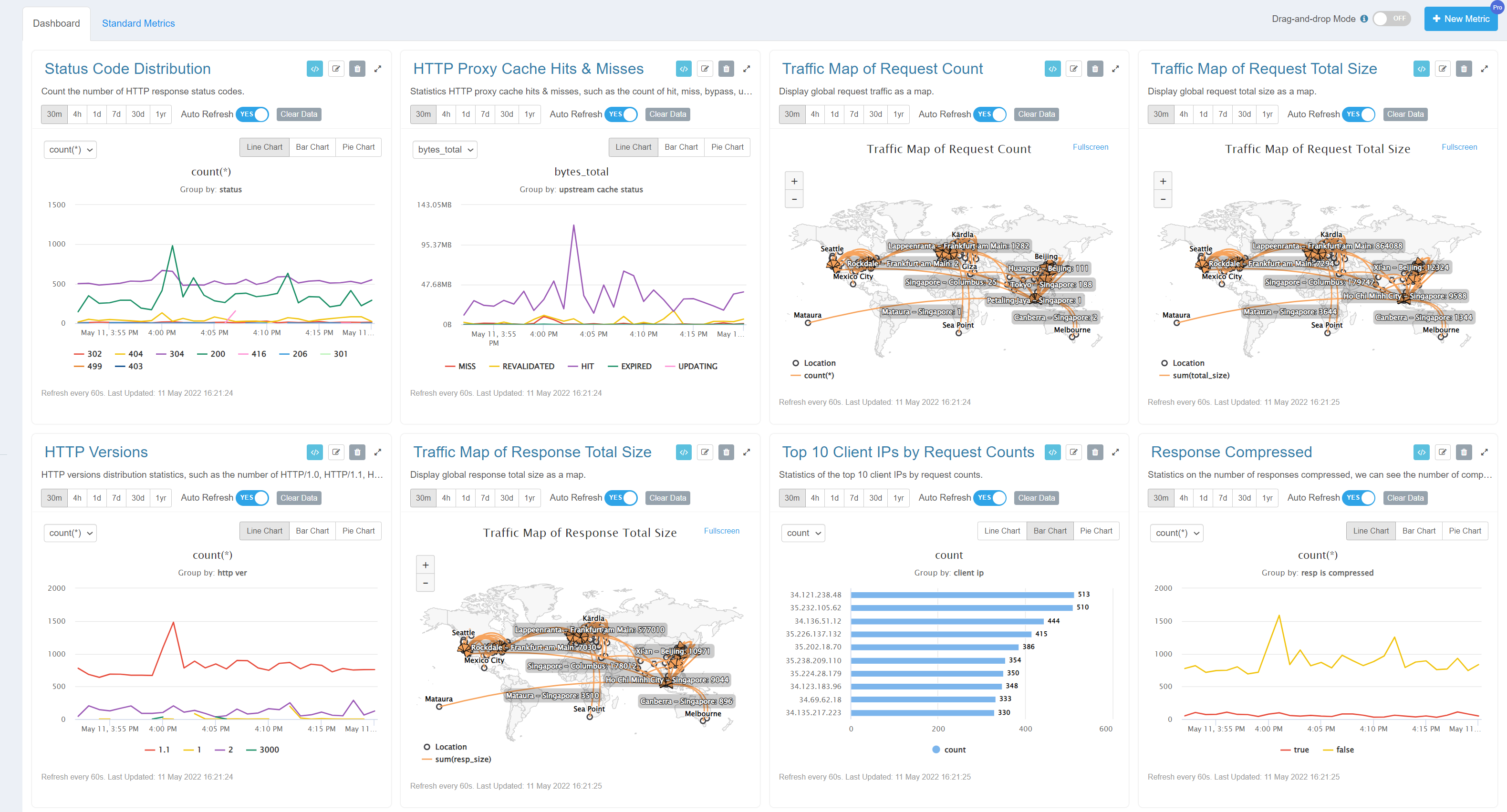
X-Forwarded-Forheader. With the real source accurately restored behind trusted proxy chains, logging, rate limiting, and authentication are all grounded in real identity. See Accurately Restore the Real Client IP Address in OpenResty Edge. - Dynamic metrics: Define and aggregate business metrics in real time with a SQL-like syntax (Metric SQL)—for example, querying the P99 latency of a particular upstream API—with no code changes and no redeployment. See How to use standard dynamic metrics in OpenResty Edge, and for advanced usage, custom dynamic metrics.
- Unified structured logs: As the mandatory path for all cross-service traffic, the gateway automatically produces structured access logs in a uniform format, ending log-schema fragmentation across teams; it also supports OpenTelemetry-standard Trace ID injection and propagation for integration with existing APM systems. For log configuration, see Configuring gateway access log files in OpenResty Edge.
Step 6: When something goes wrong—one-click rollback
When metrics turn bad mid-ramp, only one thing matters: getting back to the last known-good state in the shortest possible time. The cheaper the rollback, the bolder engineers are about releasing.
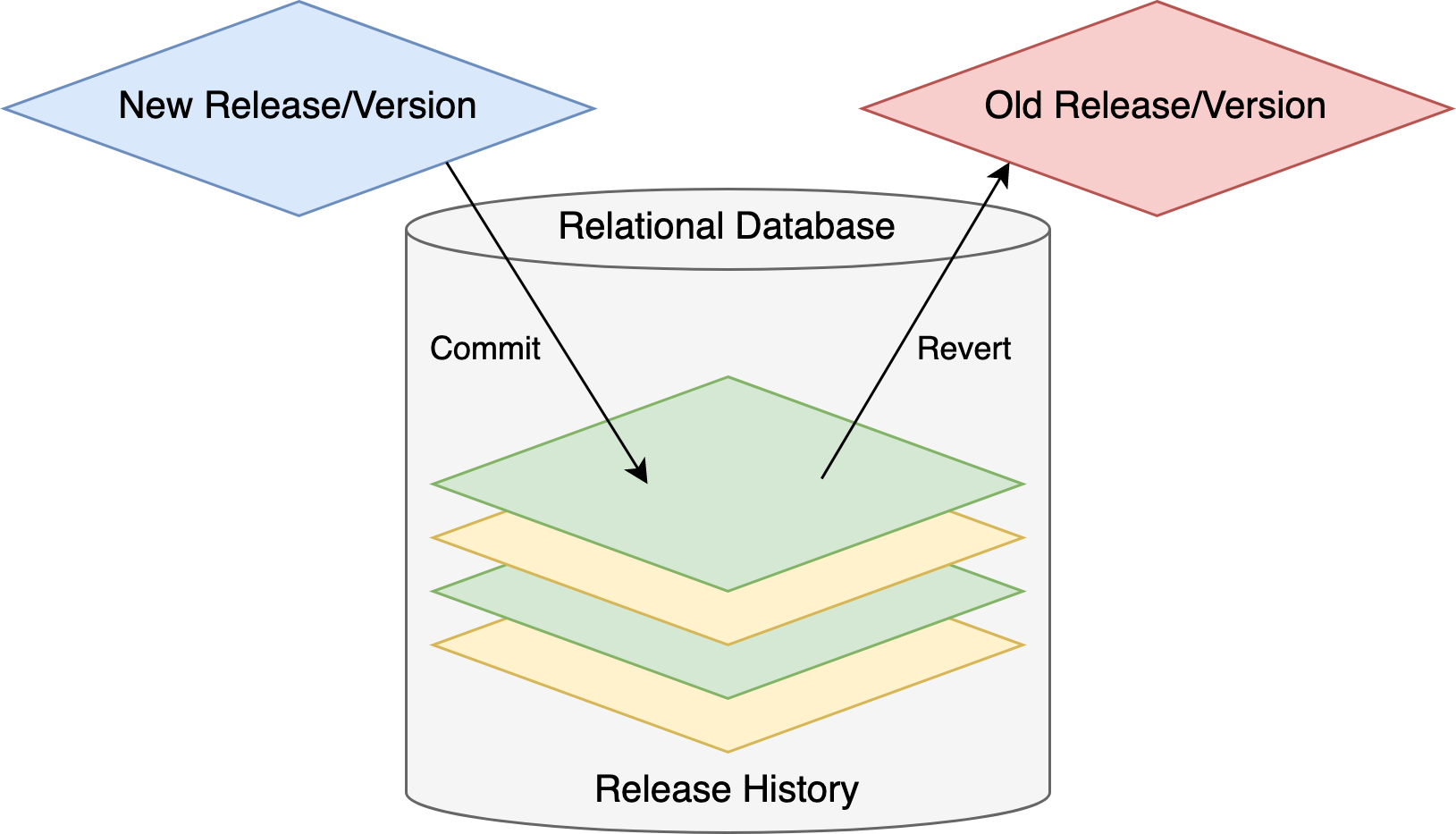
OpenResty Edge can restore to any historical release; the revision history is read-only and tamper-proof, and the console provides a human-readable diff between versions—before rolling back, you know exactly which changes will be undone. Combined with the staging validation and canary ramp-up above, “release in small steps, revert on error” closes the loop. Rollback and version comparison are covered in the same version control and release management article.
Day-2 operations: health checks, circuit breaking, and rate limiting
Beyond changes, the day-to-day resilience of internal call chains also needs a unified backstop, rather than every team hand-rolling its own inconsistent fault-tolerance code. This fault tolerance comes in two layers: the gateway’s fault tolerance for upstream business nodes, and the control plane’s monitoring of the gateway nodes themselves. The former first:
- Active and passive upstream health checks: The gateway combines active probes with passive traffic feedback to remove unhealthy upstream business nodes automatically and uphold high-availability SLAs.
- Circuit breaking and fail-fast: When upstream error rates or latency cross thresholds, circuits open automatically (fail-fast), preventing downstream thread-pool exhaustion and retry storms from crushing the system.
- Unified rate limiting: Enforce rate limits at the gateway with uniform algorithms and custom keys, replacing the mix of leaky-bucket and token-bucket implementations scattered across services. See Limit Request Rate by Custom Keys in OpenResty Edge.
The other layer is the health of the gateway nodes themselves: the Edge Admin control plane continuously probes each gateway node; nodes that fail probes are flagged red in the console and automatically removed from DNS resolution, with no human intervention. See OpenResty Edge Gateway Health Checks: Auto-Remove Failed Nodes from DNS.

For internal call chains dominated by gRPC, the gateway natively supports gRPC proxying, and the circuit breaking, health checks, and rate limiting above apply equally—the foundation for handling the “diverse protocols” characteristic of east-west traffic described earlier.
Many teams, one gateway—partition plus permission isolation
When multiple agile teams share the same gateway infrastructure, resource contention and configuration overwrites are the core pain points. The user groups and application-level access control from step 1 provide logical isolation; OpenResty Edge’s gateway partitions go further with physical isolation: each gateway node belongs to exactly one partition when enrolled, each partition has its own independent configuration space, and changes are pushed only to the clusters and nodes within that partition; a given application can be released only to designated partitions, and each partition can configure its own ports and enable Proxy Protocol per port.
Each business line maintains its own applications, page rules, and quotas inside its partition—reusing one control plane while preventing cross-team configuration overwrites and shrinking the failure blast radius; a dedicated partition can also carry the A/B testing traffic mentioned above. For the partition/cluster hierarchy and configuration practice, see How to Use Gateway Partitions in OpenResty Edge.

Auth Offload and Zero Trust for East-West Traffic
Beyond the lifecycle above, the security baseline deserves a mention of its own. Lifting authentication logic out of individual business lines and offloading it to the gateway is the first step toward a smooth landing of internal Zero Trust Architecture (ZTA): service-to-service calls can use stateless JWT signature verification (e.g., tokens issued via OAuth2/OIDC), and employee access can use OIDC integration; for highly sensitive core paths, the gateway supports mutual TLS (mTLS), authenticating machine identity with x509 client certificates; OpenResty Edge also supports JA4 fingerprinting based on TLS handshake characteristics—useful for distinguishing legitimate internal services from rogue clients even when both present valid certificates, complementing IP allowlists. Security defense thus evolves from static IP allowlists to dynamic identity and behavior validation.
When to Start: A Three-Stage Rollout Path
Never attack complex technical debt with a big-bang rewrite. Building an internal traffic governance system should be a process of small, fast steps and progressive enhancement.
This path is backed by real engineering data: after migrating to OpenResty Edge, an HR SaaS platform with thousands of employees cut the TCO of its API governance foundation by 80% and shortened configuration rollout from hours to minutes; a major OTA platform reduced gateway operations from a seven-person daily rotation to a single owner, freeing the rest to work on product features; and Qunar.com achieved zero connection loss on configuration changes at a scale of over ten billion daily calls while cutting maintenance costs by 90%. These gains came not from a one-off large-scale refactoring, but from staged, deliberate, progressive adoption.
In practice, “progressive enhancement” breaks down into three stages:
- Stage 1: Start with observability and the security baseline. Introduce JWT authentication, real client IP restoration, and standardized log collection uniformly at the gateway—without changing a single line of application code—to quickly eliminate the “unprotected system” and “black-box troubleshooting” states.
- Stage 2: Roll out traffic splitting and fault tolerance. Working with your CI/CD platform, harden “staging validation—canary ramp-up—one-click rollback” into the team’s standard release process to contain blast radius.
- Stage 3: Land Zero Trust and deep multi-tenancy. Enforce mTLS on highly sensitive service nodes; use gateway partitions to physically separate business lines’ nodes and configuration spaces; codify unified control of routing, authentication, and rate limiting as an organization-wide standard, wired into existing operational workflows via Edge Admin’s review-and-release mechanism and APIs.
Pushing the complexity of low-level networking and traffic scheduling down into a unified infrastructure layer is where cloud-native evolution inevitably leads. Only when system stability and security no longer depend on individual developers’ discipline can a microservices architecture truly deliver on business agility.
If you are evaluating an internal traffic management solution for your organization, reach out to the OpenResty Edge team for a technical consultation tailored to your specific use case.
Frequently Asked Questions (FAQ)
Q: Can internal (east-west) and external (north-south) gateways share one system? A: Yes. OpenResty Edge manages both north-south and east-west traffic with a single control plane, keeping change workflows, permission boundaries, and audit standards fully consistent; when isolation is needed, gateway partitions can place internal-facing and external-facing applications on separate physical node groups.
Q: Does introducing a centralized internal gateway conflict with a Service Mesh? A: No. The two are not mutually exclusive: Service Mesh pursues extreme pod-level decentralization at the cost of control-plane operational complexity and sidecar-induced extra latency; for most enterprises with clear service-domain boundaries, deploying a centralized gateway at key network nodes has a better return on investment—and it is a pragmatic starting point for moving toward finer-grained governance later.
Q: Where should internal traffic governance start? A: Start with observability and the security baseline—unified log collection, real client IP restoration, and JWT authentication at the gateway deliver value with zero application code changes. For the full three-stage progression from there, see the rollout path above.
Q: When should you NOT use a service mesh? A: When your services have clear domain boundaries and you lack a dedicated platform team to operate a mesh control plane. A centralized gateway at key network nodes delivers the same traffic policies—rate limiting, auth, canary releases, observability—without per-pod sidecars or the Istiod operational overhead. Start there; graduate to a mesh only if you need pod-level decentralization.
Q: Is a service mesh necessary for microservices? A: Not necessarily. Many microservice pain points—fragmented rate limiting, inconsistent auth, no canary rollback, observability silos—are infrastructure-governance gaps, not problems that require a sidecar per pod. A centralized gateway addresses them at lower operational cost.
Q: How do you handle east-west traffic without a service mesh? A: Deploy a centralized, programmable gateway at key internal network nodes. It acts as the mandatory data-plane path for inter-service calls, enforcing routing, JWT/mTLS authentication, rate limiting, circuit breaking, and structured logging—all managed from a single control plane that also covers north-south traffic. Configuration changes hot-update in memory with zero connection loss, eliminating the reload-induced flapping that plagues manual Nginx setups.
About OpenResty Edge
OpenResty Edge is a full-featured gateway platform designed for microservices and distributed traffic architectures, developed in-house by OpenResty Inc. It unifies traffic management, private CDN, API gateway, and security protection in a single product, enabling you to build, manage, and secure modern applications with ease. With industry-leading performance and scalability, OpenResty Edge handles high-concurrency, high-load environments. It supports traffic scheduling for containerized workloads including Kubernetes and can manage massive numbers of domains, making it well suited for large-scale websites and complex application deployments.
→ For the platform behind this east-west traffic approach — architecture, cases, and differences from open-source OpenResty — see What Is OpenResty Edge.
About The Author
Yichun Zhang is the creator of the open-source OpenResty® project and the CEO and founder of OpenResty Inc..
Yichun Zhang (Github ID: agentzh) was born in Jiangsu, China, and now lives in the San Francisco Bay Area. He is one of China’s earliest advocates and leading figures in open-source technology and culture, and has worked at internationally renowned technology companies such as Cloudflare, Yahoo!, and Alibaba. A pioneer in “edge computing,” “dynamic tracing,” and “machine coding,” he has over 22 years of programming experience and 16 years of open-source experience. As the leader of an open-source project used by more than 40 million domains worldwide, he built OpenResty Inc.—a high-tech company headquartered in the heart of Silicon Valley—on top of his OpenResty® open-source project. Its two flagship products, OpenResty XRay (a non-invasive fault analysis and troubleshooting tool powered by dynamic tracing technology) and OpenResty Edge (an all-in-one gateway software built for microservices and distributed traffic), are trusted by many publicly listed companies and large enterprises around the world. Beyond OpenResty, Yichun has contributed more than a million lines of code to numerous open-source projects, including the Linux kernel, Nginx, LuaJIT, GDB, SystemTap, LLVM, Perl, and others, and has authored more than 60 open-source software libraries.
Related Articles
OpenResty XRay Sep 2, 2025

OpenResty XRay Jun 27, 2024

OpenResty XRay Jun 26, 2024

OpenResty XRay May 8, 2024

OpenResty XRay Apr 28, 2024